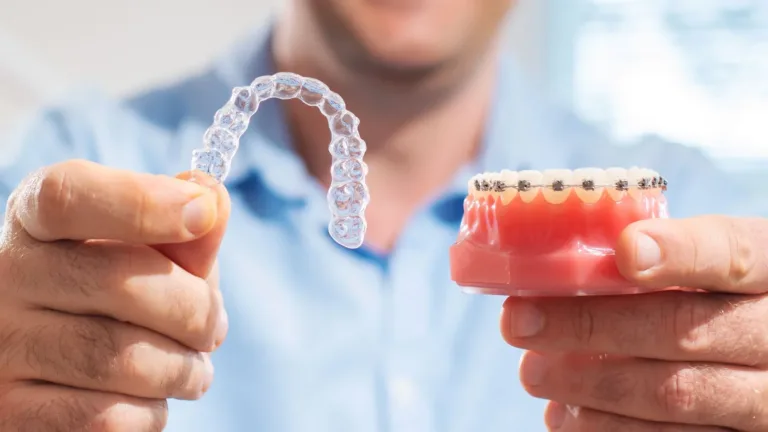
You like the idea of straighter teeth. You may be less enthusiastic about wearing braces—or about remembering to put clear trays back in after every meal.
Then come the advertisements: faster treatment, fewer appointments, an almost invisible smile transformation. It can become surprisingly difficult to work out what matters.
Neither Invisalign nor braces is automatically better for everyone. A good recommendation should explain why a particular approach fits your teeth, your bite, and your everyday life.
Invisalign is one brand of clear aligners. Braces use brackets and wires attached to the teeth; aligners use a series of removable plastic trays. Both move teeth gradually. The important differences are how they deliver that movement and what they require from you. [1–3]
First, decide what you are trying to change
“I want my front teeth straighter” is a useful starting point. It is not a complete treatment plan.
Your clinician also needs to consider how your upper and lower teeth meet, whether there is enough space, and whether your teeth and gums are healthy enough for the proposed movement. An examination and appropriate records—including X-rays when indicated—help establish that picture. [3,4]
Ask to have the problem explained in ordinary language. Is this mostly crowding? A gap? A bite problem? Are you considering a limited cosmetic change or a more comprehensive correction?
For more on the examination and preparation, read our guide to preparing for clear aligner treatment.
Those are different goals. Limited treatment can be reasonable for selected adults, but its compromises should be explained alongside the alternatives. [5]
The everyday differences
| What matters to you | Clear aligners, including Invisalign | Braces |
|---|---|---|
| Appearance | Less noticeable, although trays and tooth-colored attachments may still show | Visible brackets and wires; ceramic options may be less conspicuous |
| Taking them out | Removable, with a prescribed daily wear schedule | Attached throughout active treatment |
| Meals | Remove trays for eating; build time for removal and cleaning into your routine | Avoid foods likely to break brackets or damage wires |
| Brushing and flossing | Trays come out, making access to teeth easier | Cleaning around brackets and wires takes extra care |
| Daily responsibility | Wear the correct trays for the prescribed hours and keep track of them | Protect the appliance, clean carefully, and wear elastics if prescribed |
| After treatment | Retainers are needed | Retainers are needed |
These differences are practical considerations, not a ranking. Both approaches require consistent home care and follow-up. [1,2]
When clear aligners may fit well
Aligners appeal to people who want a less visible appliance and the ability to remove it for meals and cleaning. They can treat many spacing, crowding, and bite problems, although suitability depends on the individual case. [2]
The removable part is both the advantage and the commitment.
Expect to wear aligners for most of the day and night—commonly around 20–22 hours daily, according to your prescribed plan. They are not something you wear only while sleeping. [2,3]
Think through an ordinary Tuesday: breakfast, coffee, lunch, a snack, dinner. Can you remove, store, clean, and replace the trays consistently? Someone who drinks coffee slowly through the morning may find the routine more demanding than expected.
Be honest about that before starting. A treatment that fits your real habits is easier to follow than one designed around the habits you hope to develop.
Also ask what will be visible. Small tooth-colored attachments are often bonded to teeth to help guide movement, and some plans include elastics. “Clear” does not necessarily mean nobody will notice. [1,2]
When braces may be the stronger choice
Braces stay attached, so you do not have to remember to put the main appliance back in. They can also provide useful control when a case requires more demanding tooth movements. [1,6]
That can matter with severe crowding, extraction treatment, or a complicated bite. Some patients need additional appliances or a combination of approaches. An underlying jaw-position problem may require a specialist plan beyond simply choosing trays or brackets. [6]
This does not mean every difficult case requires braces, or that aligners are only for tiny changes. It means the clinician should explain which movements are challenging in your case and how the proposed treatment will manage them.
Braces still require participation. Cleaning, appointment attendance, food choices, and any prescribed rubber bands remain part of treatment. [1,4]
What does the research actually show?
A 2025 systematic review in the European Journal of Orthodontics examined 15 trials involving 1,084 patients. In cases treated without extractions, the pooled findings did not show a statistically significant difference in overall treatment quality or duration between aligners and fixed appliances. In extraction cases, fixed appliances produced better treatment-quality results in the included studies. [7]
That is useful evidence, but it is not a guarantee for an individual patient. The studies differed in their methods, risk of bias, and follow-up periods. Long-term comparisons were limited.
The practical interpretation is that case selection matters. Research does not support choosing one appliance as the universal winner, and results from relatively straightforward treatment should not be assumed to apply to every complex bite.
Is Invisalign faster?
Not necessarily—and braces are not automatically faster either.
Treatment time depends on the problem being corrected, the movements required, and how treatment progresses. A small alignment change and a comprehensive bite correction are not fair comparisons, even if both are advertised as “straightening teeth.” [4,7]
With aligners, ask whether the estimate includes additional trays if the teeth do not finish where planned. These additional stages are often called refinements. Clarify how progress will be assessed and what happens if the original schedule changes.
For either option, ask for a realistic range rather than treating a proposed finishing date as a promise. British Orthodontic Society guidance specifically advises explaining why treatment duration cannot be guaranteed. [8]
Which is more comfortable—and easier to keep clean?
Both can cause temporary soreness as teeth move. Brackets or wires may rub the cheeks or lips; aligners can cause irritation and temporary changes in speech. Neither option should be sold as painless. [1,3]
Removing aligners makes brushing and flossing easier to access, but it does not eliminate the risk of cavities. Sugary or acidic drinks can reach the teeth beneath the trays. Follow your clinician’s instructions about drinks, cleaning, and when to replace your aligners. [1]
With braces, plaque can collect around brackets and wires. Careful brushing, cleaning between teeth, and continued dental visits are important throughout treatment. [4,8]
The best choice is partly the one you can maintain well—not simply the one that looks easiest in a photograph.
Are there risks with either option?
Yes. Orthodontic treatment changes living tissues, and both fixed and removable appliances have risks.
These include decay or permanent enamel marks when plaque is not controlled, gum problems, and shortening of tooth roots. Small root changes are common; more extensive changes are less common but can affect tooth health. Some patients also experience unwanted bite changes or a result that falls short of the original goal. [8–10]
Ask which risks are relevant to your mouth and how they will be monitored. Mention previous dental injuries and any existing gum concerns.
A digital preview can help you understand a proposed result. It cannot establish that your teeth and supporting tissues will respond exactly as the animation suggests.
What if you already have jaw pain or clicking?
Tell your clinician before starting treatment.
Neither braces nor Invisalign should be promised as a cure for temporomandibular disorders, often called “TMJ.” The National Institute of Dental and Craniofacial Research advises caution with treatments that permanently change the teeth or bite to treat TMD. It also states that research does not support the belief that a bad bite or orthodontic treatment causes TMD. [11]
You may have a reason to straighten your teeth and a separate reason to investigate jaw pain. Those concerns deserve clear explanations rather than an assumption that one treatment will resolve both. Learn more about TMJ and orofacial pain evaluation.
Compare the complete price
A monthly payment is only one part of the decision.
Ask for a written estimate that explains the full treatment fee and what is included. Useful questions include:
- Are examinations, records, and routine monitoring included?
- What happens to the fee if treatment takes longer?
- Are additional aligner stages, replacement trays, or bracket repairs included?
- Are retainers and follow-up after active treatment included?
- What would happen if I needed to change treatment approaches?
These are questions to ask, not assumptions that every office charges separately.
If you have insurance, verify the orthodontic benefit for your specific plan and proposed treatment. Do not assume that general dental coverage automatically includes adult orthodontics. [2,4]
Retainers belong in the decision from the beginning
Teeth can shift after both braces and aligners.
Retainers help maintain the new positions. The early period after treatment is particularly important, but the tendency to change does not disappear after a few months. Long-term retention is commonly recommended. [12]
Your clinician may recommend removable retainers, fixed retainers bonded behind the teeth, or a combination. Each needs care. Fixed retainers require cleaning and inspection; removable retainers require consistent wear and occasional replacement.
Before beginning treatment, understand the proposed retention schedule, who will check the retainers, and what replacement might cost. The final tray or the day the brackets come off is not the end of maintaining your result.
Five questions that make the consultation worthwhile
- Could my case be treated well with either option? If not, what specifically makes one more suitable?
- What will this plan improve, and what will it leave unchanged?
- What will I need to do every day, and what could extend treatment?
- Who will monitor my teeth, gums, and bite—and when would specialist care be appropriate?
- What is the complete cost, including possible additional treatment and retainers?
General dentists and orthodontists can provide orthodontic care, depending on their experience and the complexity of the case. An orthodontist has additional specialist training. A specialist opinion is particularly useful when the bite is complex, recommendations conflict, or the proposed compromises are unclear. [4]
You do not need to choose an appliance before the consultation. You need enough information to understand the recommendation.
If you are considering clear aligners in Issaquah, explore clear aligner care at Highlands Dentistry or request an appointment to discuss your teeth, your goals, and whether an orthodontic referral would be appropriate.
This article provides general patient education. Treatment recommendations require an individual examination.
Sources and further reading
- American Association of Orthodontists. Aligners vs. Braces: A Comparison. aaoinfo.org
- American Association of Orthodontists. Clear Aligners. aaoinfo.org
- U.S. Food and Drug Administration. Clear Dental Aligners. fda.gov
- American Dental Association, MouthHealthy. Braces. mouthhealthy.org
- British Orthodontic Society. Limited Treatment Orthodontics. bos.org.uk
- British Orthodontic Society. Clear aligners. bos.org.uk
- Alhafi ZM, Hajeer MY, Alam MK, Jaber ST. Quality and stability of orthodontic treatment outcomes with clear aligners versus fixed appliances: a systematic review and meta-analysis. European Journal of Orthodontics. 2025;47(6). doi:10.1093/ejo/cjaf091. PubMed
- British Orthodontic Society. Risks of Orthodontic Treatment: Advice Sheet. bos.org.uk (PDF)
- British Orthodontic Society. Clear Aligners: Patient Information. bos.org.uk (PDF)
- British Orthodontic Society. What can go wrong with braces? bos.org.uk
- National Institute of Dental and Craniofacial Research. TMD (Temporomandibular Disorders). nidcr.nih.gov
- British Orthodontic Society. What happens when my braces are removed? Will I need retainers? bos.org.uk
Sources checked September 24, 2026.