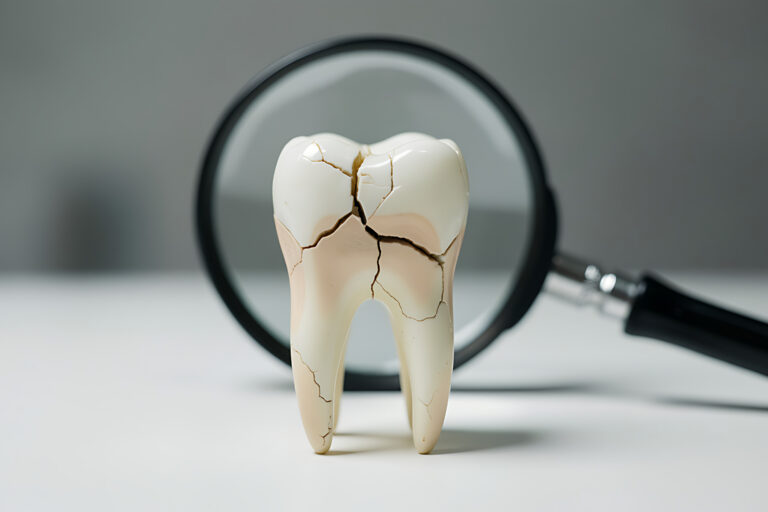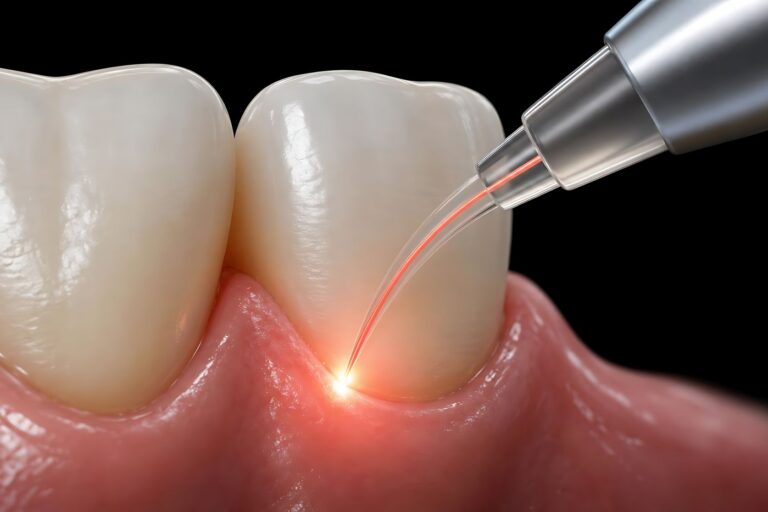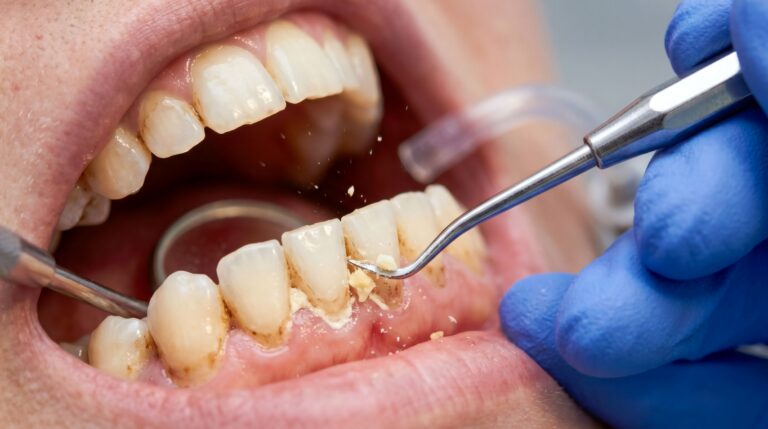
“Deep cleaning” is an informal phrase. The clinical treatment is usually called scaling and root planing, and it is not simply a longer version of a routine cleaning.
A routine cleaning is generally intended to remove plaque, stain, and hardened deposits around teeth with healthy gums or gingivitis. Scaling and root planing is nonsurgical treatment for periodontal disease, where bacterial deposits and inflammation extend below the gumline and the supporting tissues around teeth have been damaged.
So yes, some patients genuinely need it. Others may need improved home care, treatment for gingivitis, and an appropriate routine cleaning. The recommendation should come from a periodontal diagnosis supported by measurable findings—not from the phrase “deep cleaning” by itself.
The four pieces of evidence that matter
A responsible periodontal diagnosis usually combines several findings rather than relying on one number.
- Pocket depths. A periodontal probe measures the space between the gum and tooth. Deeper readings can be a sign of disease, but inflammation, swelling, recession, and tissue shape can affect the measurement. Pocket depth should not be interpreted by itself.
- Bleeding and inflammation. Bleeding during gentle probing suggests inflamed tissue. It is important, but bleeding alone does not prove that supporting bone or attachment has been lost.
- Clinical attachment loss. This estimates how much of the tooth’s supporting attachment has been lost from its original position. Current periodontal staging places substantial weight on clinical attachment loss when determining disease severity.
- Bone levels on appropriate X-rays. Radiographs can help show whether bone has been lost, how the loss is distributed, and whether the pattern appears horizontal, vertical, localized, or generalized.
Other findings may include gum recession, plaque and calculus, tooth mobility, furcation involvement between the roots of molars, previous tooth loss from periodontal disease, smoking or nicotine use, diabetes, and evidence of how quickly the condition has progressed.
A recommendation that cannot be connected to actual measurements deserves questions.
Gingivitis is not the same as periodontitis
Gingivitis is inflammation confined to the gum tissue. The gums may bleed, look swollen, or feel tender, but the attachment and bone supporting the teeth have not been destroyed. Early plaque-related gum inflammation can often be reversed with effective daily plaque removal and professional care.
Periodontitis includes loss of the tissues and bone supporting the teeth. It can sometimes progress with little or no pain. Treatment aims to control inflammation and infection, remove deposits that cannot be reached at home, improve daily plaque control, and create conditions that can be maintained over time.
This distinction explains two things that may initially seem contradictory:
- Bleeding gums do not automatically mean that you need scaling and root planing.
- A tooth that does not hurt may still have meaningful periodontal disease.
The diagnosis depends on the pattern of findings—not pain alone and not a single bleeding site.
What scaling and root planing is meant to accomplish
During nonsurgical periodontal treatment, the dentist or dental hygienist removes bacterial deposits, plaque, and calculus from tooth and root surfaces below the gumline. Local anesthesia is often used for comfort, and treatment may be completed in sections depending on the extent of disease and the patient’s needs.
The objective is not simply to make the roots feel smooth. The larger purpose is to reduce the bacterial burden and inflammation, make the area easier to maintain, and give the tissues an opportunity to heal.
The treatment is also not complete when the instruments stop. A meaningful plan includes reassessment:
- Has bleeding decreased?
- Have inflamed tissues tightened?
- Have probing depths improved?
- Can previously difficult areas now be kept clean?
- Are deep or bleeding sites still present?
- Is additional periodontal treatment needed?
Evidence-based periodontal care is generally organized as a stepwise process: control plaque and risk factors, perform subgingival instrumentation where indicated, reassess healing, address residual disease, and establish supportive periodontal care.
What a “deep cleaning” cannot promise
Scaling and root planing can be highly useful when the diagnosis is appropriate, but it is not a guarantee that every pocket will return to health or that no further treatment will ever be needed.
Response depends on factors such as:
- The severity and pattern of disease
- The depth and anatomy of affected sites
- Furcation involvement around molars
- Smoking or nicotine exposure
- Diabetes control
- Daily plaque removal
- The patient’s healing response
- Whether difficult areas can be maintained over time
Some sites respond well to nonsurgical care. Others may still require periodontal referral, additional instrumentation, surgical treatment, or closer maintenance.
That does not necessarily mean the original treatment failed. It means periodontal care must be evaluated by measurable healing—not assumed from the fact that treatment was completed.
Why maintenance may be different afterward
A routine six-month cleaning and periodontal maintenance are not interchangeable labels.
After treatment for periodontitis, the ongoing visit is designed around a history of attachment or bone loss. The clinician may need to reassess specific pockets, bleeding, plaque control, mobility, furcations, and risk factors more closely than during a routine preventive cleaning.
The appropriate interval should be individualized. It may change as inflammation, plaque control, health conditions, smoking status, and stability change.
The practical question is not:
“How often does everyone need to come back?”
It is:
“How often do these particular sites need to be monitored and maintained?”
Questions you should be able to ask without feeling difficult
A clear periodontal recommendation should make these questions answerable:
- What is my actual periodontal diagnosis?
- Which pocket measurements are concerning?
- Where is clinical attachment loss present?
- Where can I see bone loss on the X-rays?
- Is the condition localized or generalized?
- Are some areas gingivitis while others have periodontitis?
- What risk factors make progression more likely in my case?
- What would happen if treatment were delayed?
- Is a home-care phase and reassessment reasonable, or would waiting create unnecessary risk?
- What result should we expect after treatment?
- When will healing be measured?
- What will maintenance look like afterward?
A trustworthy office should welcome these questions. Treatment usually becomes less frightening when the findings are visible and the purpose is clear.
When a second opinion is reasonable
A second opinion may be useful when:
- No periodontal charting was performed
- The diagnosis was not explained
- Bone or attachment loss was never shown
- Every area of the mouth received the same recommendation without explanation
- Extensive treatment was proposed without discussing alternatives
- The expected outcome and maintenance plan were unclear
- The recommendation seemed based only on bleeding or one unexplained X-ray
Seeking another opinion does not automatically mean the first dentist was wrong. Periodontal findings can sit near diagnostic or treatment thresholds, and clinicians may reasonably differ on timing or the extent of treatment.
The purpose of a second opinion is not to search until someone says “no treatment.” It is to understand the evidence well enough to make an informed decision.
Common patient questions
Does bleeding mean I automatically need a deep cleaning?
No. Bleeding is evidence of inflammation, but it does not by itself establish attachment or bone loss. It should be interpreted alongside pocket measurements, attachment levels, radiographs, and the overall disease pattern.
Can an X-ray alone prove that I need scaling and root planing?
Usually not by itself. X-rays can reveal bone loss, but they do not show current inflammation, bleeding, plaque control, or every soft-tissue measurement. Diagnosis is based on the clinical examination and radiographs together.
Is scaling and root planing painful?
Local anesthesia is often used during treatment. Temporary tenderness, bleeding, or sensitivity may occur afterward, but the experience varies by person and by the areas treated.
Is one deep cleaning enough forever?
Not necessarily. Treatment should be followed by reassessment and an individualized maintenance plan. Some areas may stabilize with nonsurgical care; persistent deep or bleeding sites may require additional attention.
The honest bottom line
Do not accept or reject periodontal treatment merely because the words “deep cleaning” sound expensive or aggressive.
Ask to see the disease the treatment is intended to manage.
When periodontitis is present, delaying appropriate care can permit further attachment and bone loss. When periodontitis is not present, labeling routine gum inflammation as advanced disease is unnecessary.
The correct plan begins with a correct diagnosis.
Looking for a careful second opinion or a new dental home? Learn more about general dentistry at Highlands Dentistry or request an appointment.
Clinical references
- American Dental Association. Scaling and Root Planing for Gum Disease.
- National Institute of Dental and Craniofacial Research. Periodontal (Gum) Disease.
- American Academy of Periodontology. Staging and Grading Periodontitis.
- European Federation of Periodontology. Guideline on Treatment of Stage I–III Periodontitis.