Gum disease is not a cleaning problem. And the laser is the most advertised part of the treatment rather than the most important part. Both of those facts should change what you ask for.
You notice it in the sink. A thin pink swirl after flossing, or a stripe of red on the brush head. You notice it once and it startles you. You notice it a second time and you decide you were brushing too hard. By the third or fourth time, you’ve stopped noticing it at all.
That normalization is the whole disease in miniature. Because if any other tissue in your body bled every time you touched it, you would not adjust your technique. You would make an appointment.
Bleeding is not a hygiene failure. It’s a wound.
The standard explanation people get is some version of you’re not flossing enough, and that explanation is usually true as far as it goes. The problem is that it stops one question too early, and it puts the entire burden on effort — as though the tissue is sulking and will cheer up if you try harder.
Here is what’s actually happening. Bacteria in the mouth organize into biofilm — a structured, adherent, cooperative community that re-forms on tooth surfaces within hours of being removed. Left undisturbed, that biofilm matures and its composition shifts toward organisms that prefer the low-oxygen environment of the crevice between tooth and gum. Your immune system responds the way it responds to any persistent invader: it floods the area with blood, fluid, and inflammatory cells. That’s the redness, that’s the swelling, and that’s why the capillaries sitting just under a thinned, ulcerated tissue surface let go when you touch them.
So bleeding is not evidence of a technique problem. It is evidence of an active immune response — a small, chronic, open wound in your mouth that you have been rinsing away every morning.
The part that matters: the damage isn’t done by the bacteria
This is the piece almost nobody explains, and it reorganizes everything downstream.
The bone and attachment loss that defines serious gum disease is not primarily bacterial demolition. It’s collateral damage from your own inflammatory response, running continuously for years. Inflammation is a blunt instrument. Sustained long enough, it begins dissolving the collagen fibers that attach gum to tooth, and then the bone that holds the tooth in the jaw.
Which means gum disease is better understood as a dysregulated host response to a bacterial challenge than as an infection you can simply out-clean. It also explains why two people with visually similar plaque levels can have wildly different outcomes: one has a proportionate response, the other has an immune system that overcommits. Genetics, smoking, diabetes, stress, and medication all sit on that dial.
Gingivitis and periodontitis are not two grades of the same thing
They are two different situations, and the line between them is the most consequential line in the entire subject.
Gingivitis is inflammation confined to the soft tissue. The attachment and the bone underneath are intact. This is reversible — genuinely, completely reversible — with thorough professional debridement and consistent home care.
Periodontitis means the inflammation has breached the attachment. The crevice deepens into a pocket: a space too deep for a brush or floss to reach, which then functions as a protected reservoir for exactly the bacteria that created it. Bone begins to resorb. The loop becomes self-reinforcing — deeper pocket, more sheltered organisms, more inflammation, more bone loss, deeper pocket.
Periodontitis is manageable, often very successfully. But it is arrested, not reversed. Bone already lost does not return on its own. That single asymmetry is why timing matters more than technique here, and why the disease’s most dangerous feature is that it is usually painless until late. Teeth don’t ache. They loosen. People often come in worried about a tooth that “feels different” when they bite, and the tooth is perfectly healthy — it’s the foundation that has changed.
This is not a rare situation. In a nationally representative survey, an estimated 42% of dentate US adults aged 30 and older had periodontitis, with 7.8% in the severe category.
Which brings us to the laser
If you’ve searched for gum treatment recently, you have seen the word laser attached to a great deal of confident language. I want to walk through what the evidence actually supports, because this is a place where marketing has moved considerably faster than the literature, and where a patient can be sold on a technology instead of a treatment.
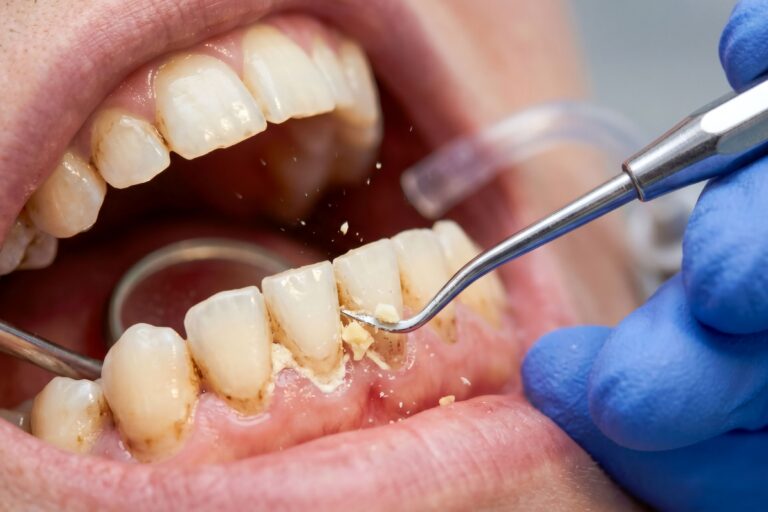
Start with what is not in dispute. Biofilm and the calcified deposits it mineralizes into have to be physically removed. There is no rinse, no pill, and no wavelength of light that substitutes for mechanical debridement of the root surface. Scaling and root planing — meticulous instrumentation below the gumline, under local anesthetic, typically over two visits — is the foundation of non-surgical periodontal therapy, and it has held that position for decades under continuous re-examination.
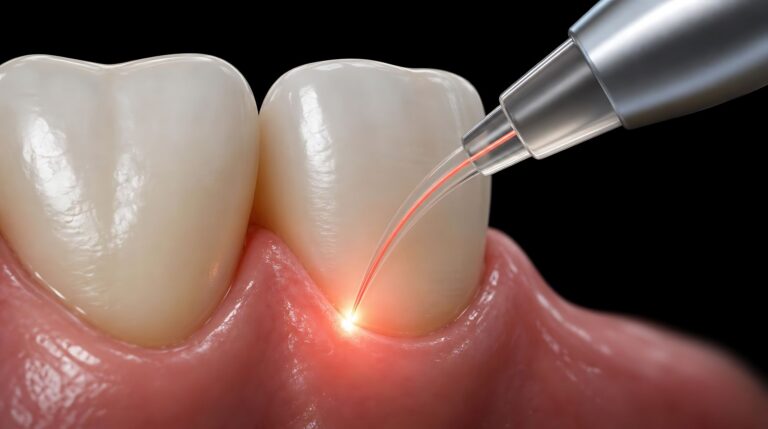
Now the laser. A dental laser is concentrated light at a specific wavelength, and different tissues absorb different wavelengths differently. That selectivity is real physics and it produces real clinical effects: laser energy can reduce bacterial load in the pocket, ablate diseased soft tissue, and seal small vessels as it works, which is why laser-assisted procedures often involve less bleeding during treatment and, for many patients, a more comfortable few days afterward.
The question is not whether lasers do something. It’s how much they add on top of good debridement, and the honest answer is modest, inconsistent, and dependent on which laser, which technique, and which pocket.
The American Academy of Periodontology has now looked at this twice. Its 2011 statement concluded that there was minimal evidence to support laser use for subgingival debridement, either as a monotherapy or as an adjunct to scaling and root planing. Its 2018 Best Evidence Consensus was more favorable but still carefully bounded: the panel described a modest additional benefit — under a millimeter — in probing depth reduction and clinical attachment level gain from adjunctive laser use, within a consensus format that expressly characterizes its own evidence base as insufficient to support broad conclusions or clinical practice guidelines. The systematic reviews since have landed in the same neighborhood — statistically detectable improvements in some protocols and some follow-up windows, inconsistent across wavelengths and application regimens, and generally measured in fractions of a millimeter.
Fractions of a millimeter are not nothing. But they are also not what the advertising implies.
The mechanism most often advertised is the one the evidence deprioritizes
Here’s the detail that I think is genuinely interesting, and it’s the reason I wanted to write this post rather than a friendlier one.
A great deal of laser marketing centers on removing the diseased lining of the pocket — the inflamed soft tissue wall. It’s an intuitive story and it photographs well. But the AAP has stated the opposite emphasis: therapies intended to arrest and control periodontitis depend primarily on effective debridement of the root surface, not on removal of the lining of the pocket soft tissue wall. Curettage of that tissue wall — mechanical, chemical, or laser — has shown little to no benefit beyond scaling and root planing alone.
So the mechanism most prominently sold is the mechanism the evidence weights least. That is worth knowing before you pay for it.
None of which makes the laser useless. It makes it an adjunct with a real but bounded effect, most defensible in deeper pockets, where the geometry works against instruments and where the consensus panel found what benefit there was concentrated.
So should you have it?
The version of this answer I’d give across the operatory, without the website voice on:
A laser is reasonable if you have moderate-to-deep pocketing that hasn’t fully resolved with conventional therapy, if you bleed easily or take anticoagulants, or if a more comfortable recovery is the difference between you completing treatment and avoiding it. That last one is not a small consideration. A therapy you’ll actually finish beats a superior therapy you won’t.
A laser is not the right answer if it’s being offered instead of thorough debridement, if it’s being sold as a way to skip the deep cleaning, or if you have healthy gums and are being offered an upgrade to a problem you don’t have. And it is not sufficient on its own for advanced disease with significant bone loss or mobile teeth, where surgical or regenerative approaches — or a periodontist’s involvement — may be the right call. Part of the job is telling you when the answer is a referral.
What I’d be skeptical of, from any office: promises of a painless procedure, claims of regrowing bone that aren’t tied by name to a specific device with specific clearance for that claim, and any version of “the laser replaces the cleaning”.
Why your physician may care about this too
Periodontal inflammation does not stay politely local, and the research on systemic links has matured considerably.
The diabetes relationship is the best characterized and runs in both directions. Poorly controlled diabetes increases risk and severity of periodontitis, and periodontitis is associated with increased risk of incident type 2 diabetes. On the treatment side, the joint EFP/IDF consensus reported that periodontal therapy is safe and effective in people with diabetes and is associated with HbA1c reductions of roughly 0.27–0.48% after three months — with the honest caveat that studies involving longer-term follow-up are inconclusive. An earlier joint EFP/AAP consensus, working from a figure of about 0.4%, described that magnitude of change as a clinical impact equivalent to adding a second drug to a pharmacological regimen for diabetes. That is a striking way to frame a dental cleaning.
For cardiovascular and respiratory disease, the evidence describes association, and mechanisms are still being worked out. So the responsible statement is narrow: treating gum disease is not a treatment for heart disease, and any office telling you otherwise is overselling. But a persistent inflammatory burden covering a surface area of ulcerated tissue in your mouth is not a trivial thing to carry for twenty years, and that’s a defensible reason to take it seriously on its own terms.
The interval is the treatment
Here’s the part that doesn’t make it onto anyone’s technology page.
Biofilm re-forms in hours. Not weeks — hours. Which means the result achieved in the operatory begins eroding the moment you walk out, and what determines whether you’re stable in ten years is not which wavelength was used. It’s whether you came back every three to four months for periodontal maintenance, and whether you cleaned between your teeth on ordinary, unremarkable Tuesdays.
The three-month interval isn’t a billing convention. It approximates how long it takes for a destructive bacterial community to re-establish itself in a previously diseased pocket. We are interrupting a clock.
And that’s the good news buried in all of this. Small, boring, repeated inputs produce disproportionate results over a decade. Very few things in health compound this cleanly.
The reframe
Most of the marketing in this category invites you to ask which technology will fix my gums. That’s the wrong first question, and asking it puts you at the mercy of whoever has the most impressive equipment brochure.
The better questions are: what are my actual numbers, how deep is the deepest pocket, how much bone have I already lost, what is driving my inflammatory response, and what interval keeps me stable? Answer those and the laser question resolves itself — it becomes a reasonable, bounded addition in some mouths and an unnecessary expense in others.
The technology is the visible part. The measurement and the interval do the work.
If you noticed pink in the sink this morning, that’s worth a look — not urgently, not fearfully, but soon, and with a full set of measurements rather than a glance.
Schedule a periodontal evaluation →
Common questions
Can gum disease be reversed?
Gingivitis, in which inflammation is confined to the soft tissue, is reversible with thorough professional cleaning and consistent home care. Periodontitis, in which attachment and bone have been lost, is generally arrested and controlled rather than reversed. Bone already lost does not return on its own.
Does a laser replace a deep cleaning?
No. Hardened deposits below the gumline must be physically removed through scaling and root planing. The available evidence indicates that arresting periodontitis depends primarily on debridement of the root surface. Laser therapy is studied as an adjunct to that debridement, not as a substitute for it.
Is laser gum treatment painful?
It is performed with local anesthetic, and many patients describe the days afterward as tender rather than painful. Individual experience varies, and comfort is not something any office can promise in advance.
Is laser treatment worth the added cost?
That depends on your specific findings. Consensus reviews describe a modest benefit from adjunctive laser use, concentrated in deeper pockets, alongside an acknowledgment that the evidence is not strong enough to support blanket recommendations. It is a reasonable option for some patients and unnecessary for others, and the measurements should decide.
Why do I need cleanings every three months instead of every six?
Because bacterial biofilm re-establishes itself in a previously diseased pocket on roughly that timescale. The shorter interval for patients with a periodontitis history is an attempt to interrupt that cycle before it does further damage.
My gums bleed but nothing hurts. Is that urgent?
Periodontitis is typically painless until it is advanced, which is exactly why bleeding without pain deserves attention rather than reassurance. The evaluation is measurement-based and straightforward.
References
- Eke PI, Thornton-Evans GO, Wei L, Borgnakke WS, Dye BA, Genco RJ. Periodontitis in US Adults: National Health and Nutrition Examination Survey 2009–2014. J Am Dent Assoc. 2018;149(7):576–588.e6.
- American Academy of Periodontology. Statement on the efficacy of lasers in the non-surgical treatment of inflammatory periodontal disease. J Periodontol. 2011;82(4):513–514.
- Mills MP, Rosen PS, Chambrone L, et al. American Academy of Periodontology best evidence consensus statement on the efficacy of laser therapy used alone or as an adjunct to non-surgical and surgical treatment of periodontitis and peri-implant diseases. J Periodontol. 2018;89(7):737–742.
- Chambrone L, Ramos UD, Reynolds MA. Infrared lasers for the treatment of moderate to severe periodontitis: an American Academy of Periodontology best evidence review. J Periodontol. 2018;89(7):743–765.
- Smiley CJ, Tracy SL, Abt E, et al. Systematic review and meta-analysis on the nonsurgical treatment of chronic periodontitis by means of scaling and root planing with or without adjuncts. J Am Dent Assoc. 2015;146(7):508–524.e5.
- Yu S, Zhao X, Zhang Y, Liu Y, Li A, Pei D. Clinical effectiveness of adjunctive diode laser on scaling and root planing in the treatment of periodontitis: is there an optimal combination of usage mode and application regimen? A systematic review and meta-analysis. Lasers Med Sci. 2022;37(2):759–769.
- Cobb CM, Sottosanti JS. A re-evaluation of scaling and root planing. J Periodontol. 2021;92(10):1370–1378.
- Sanz M, Ceriello A, Buysschaert M, et al. Scientific evidence on the links between periodontal diseases and diabetes: consensus report and guidelines of the joint workshop on periodontal diseases and diabetes by the International Diabetes Federation and the European Federation of Periodontology. J Clin Periodontol. 2018;45(2):138–149.
- Chapple ILC, Genco R; working group 2 of the joint EFP/AAP workshop. Diabetes and periodontal diseases: consensus report of the Joint EFP/AAP Workshop on Periodontitis and Systemic Diseases. J Clin Periodontol. 2013;40(Suppl 14):S106–S112.
- Herrera D, Sanz M, Shapira L, et al. Association between periodontal diseases and cardiovascular diseases, diabetes and respiratory diseases: consensus report of the Joint Workshop by the European Federation of Periodontology (EFP) and the European arm of the World Organization of Family Doctors (WONCA Europe). J Clin Periodontol. 2023;50(6):819–841.
Ray Besharati is a practicing general dentist and the owner of Highlands Dentistry in Issaquah, Washington. He holds a DMD from Tufts University and a master’s degree in orofacial pain from the University of Southern California, and has practiced clinical dentistry for more than 25 years.
This article is general education and not a substitute for an individual evaluation. Periodontal findings, treatment options, and outcomes vary from patient to patient.