You have a tooth with a large filling. Or your dentist points out a crack. The tooth may not hurt, yet a crown enters the conversation.
Some teeth benefit from a crown; others can be monitored or treated more conservatively. The decision depends on the tooth’s condition—not simply how old the filling is or whether the tooth hurts. 1, 3, 4
There are two questions to work through: does the tooth need treatment, and if it does, how much protection does it need?
Do I need a crown if my tooth doesn’t hurt?
A tooth can need protection before it hurts. A crack or weakened tooth wall may be present without noticeable symptoms. Your dentist should explain the structural finding that makes treatment advisable, rather than using pain as the only guide. 9
In a large U.S. cracked-tooth registry, decay and pain when biting were strongly associated with dentists recommending restoration. Pain without a trigger was another factor. These findings help explain treatment decisions; no single symptom automatically establishes that a crown is the right treatment. 5
The question to ask is: what specific finding makes you concerned about leaving this tooth as it is?
Does a large or old filling mean I need a crown?
The condition of the filling and the tooth around it matters more than the filling’s age alone. A small, localized problem in an otherwise serviceable filling may sometimes be repaired instead of replacing the whole restoration. 1
A clinical study following selected amalgam and composite fillings for 12 years supports repair as a reasonable option in suitable cases. It was a small study, and it does not show that extensive decay or badly weakened tooth walls can always be managed with a repair. 1
Ask whether the concern is the filling itself, the tooth supporting it, or both.
Can a cracked tooth be watched instead of crowned?
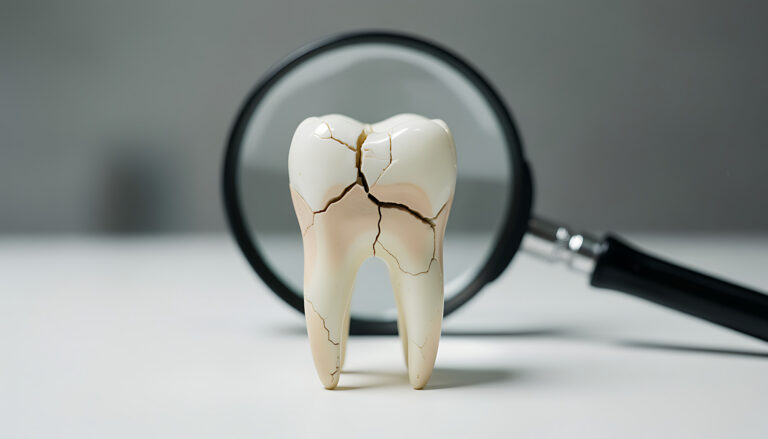
Some lower-risk cracks can be monitored after an examination. A superficial enamel line, called a craze line, differs from a crack extending deeper into the tooth. Craze lines generally need no treatment for tooth health. Current expert guidance also allows periodic review of selected shallow cracks when the pulp—the tissue containing nerves and blood vessels—and surrounding tissues appear healthy. 2
A U.S. study enrolled 2,858 adults, each with a back tooth containing a visible crack and a living pulp. Among teeth initially selected for monitoring in the follow-up analysis, about 80% continued with a monitoring recommendation during the three-year study. 3
That does not mean 80% of all cracked teeth need no treatment. Dentists and patients selected the management approach, treatment was not randomly assigned, and follow-up was incomplete. The finding supports careful selection and reassessment; it does not establish lifetime safety. 3
A tooth with more extensive damage may need active treatment. Some fractures cannot be managed with a crown, so the dentist must first establish whether the tooth can be restored. 2
Can I get an onlay instead of a full crown?
An onlay may be an option when selected parts of the tooth need coverage. A full crown covers the prepared tooth’s chewing surface and sides. An onlay covers part of the tooth, including one or more chewing cusps—the raised points on a back tooth—and may preserve more healthy structure. 4
A systematic review found no statistically significant survival difference between onlays or partial crowns and full crowns at one and three years. The evidence was limited and largely observational, so it does not prove that the options are equally suitable for every tooth or equally durable over decades. 4
The aim is to provide enough protection while preserving as much sound tooth as possible.
Do all teeth need crowns after a root canal?
Not every root-canal-treated tooth needs the same restoration. Back teeth often benefit from coverage of their chewing cusps, especially when a side wall is missing. An appropriately selected onlay can provide that coverage. A relatively intact front tooth, or a carefully selected back tooth with thick remaining walls and no cracks, may have different needs. 6
Choosing a filling instead of a crown is still treatment. It is different from leaving a root-canal-treated tooth without its appropriate final restoration. 6
A small randomized trial published in 2026 illustrates another tradeoff. All studied teeth had glass-fiber posts to help retain their restorations. Crowns needed fewer repairs than composite fillings during follow-up of up to 14 years, while filling failures were more often repairable. Neither group was left untreated. Those findings apply to that selected group of teeth, rather than every tooth with a filling. 7
What are the downsides of getting a crown?
Preparing a full crown removes tooth structure irreversibly. Some previously living teeth later develop pulp problems that may require root canal treatment. A systematic review documented these complications after indirect restorations, but the evidence was low certainty and involved different restorations and follow-up periods. Existing decay and previous tooth damage also matter; a later pulp problem cannot automatically be attributed to crown preparation alone. 8
The decision should weigh the protection a crown can provide against the costs and risks of treatment.
How often should a tooth being watched be checked?
Your dentist should set a reassessment plan for that particular tooth. The plan should identify what is being monitored, when it will be checked, and what would trigger treatment. If decay, infection, or structural damage needs treatment, watching should not simply mean waiting for pain. 9
Assessment may involve bite testing, pulp testing, checking the gums, and appropriate X-rays. A normal-looking X-ray does not rule out a crack. 2
Watching a tooth should mean a documented plan and a scheduled reassessment—not simply waiting for it to hurt.
When should I call the dentist sooner?
Contact your dentist promptly for new biting pain, persistent temperature sensitivity, pain without a trigger, swelling, or a newly broken piece. These changes need assessment; they do not, by themselves, tell you which treatment is needed. 9
For urgent dental concerns, call our office at (425) 996-0457. Please do not use the online evaluation form for urgent or emergency concerns.
What should I ask before agreeing to a crown?
- Can you show me the finding and explain what it means?
- Is monitoring reasonable for this tooth, and what is the risk of waiting?
- Could a repair or an onlay provide adequate protection?
- If we monitor it, when will we review it, and what would change the plan?
You deserve an explanation you understand: what is damaged, what remains strong, what each option can achieve, and what uncertainty remains.
Learn more about our general and restorative dental care, or request an evaluation to discuss your tooth and your options.
This article concerns permanent teeth and provides general education, not an individual diagnosis.
References
- Estay J, et al. 12 Years of Repair of Amalgam and Composite Resins: A Clinical Study. Operative Dentistry. 2018;43(1):12–21. doi:10.2341/16-313-C.
- Patel S, et al. Position statement on longitudinal cracks and fractures of teeth. International Endodontic Journal. 2025;58(3):379–390. doi:10.1111/iej.14186.
- Ferracane JL, et al. Outcomes of treatment and monitoring of posterior teeth with cracks: three-year results from the National Dental Practice-Based Research Network. Clinical Oral Investigations. 2022;26(3):2453–2463. doi:10.1007/s00784-021-04211-0.
- Wang B, et al. Onlays/partial crowns versus full crowns in restoring posterior teeth: a systematic review and meta-analysis. Head & Face Medicine. 2022;18:36. doi:10.1186/s13005-022-00337-y.
- Hilton TJ, et al. Recommended treatment of cracked teeth: Results from the National Dental Practice-Based Research Network. Journal of Prosthetic Dentistry. 2020;123(1):71–78. doi:10.1016/j.prosdent.2018.12.005.
- European Society of Endodontology; Mannocci F, Bhuva B, Roig M, Zarow M, Bitter K. European Society of Endodontology position statement: The restoration of root filled teeth. International Endodontic Journal. 2021;54(11):1974–1981. doi:10.1111/iej.13607.
- Galdino-Santos L, et al. Randomized clinical trial comparing the clinical performance of metal-ceramic crowns and direct composite resin retained with glass fiber posts: Long-term results after up to 14 years. Dental Materials. 2026;42(7):1120–1132. doi:10.1016/j.dental.2026.02.023.
- Al-Manei KK, et al. Incidence and influential factors in pulp necrosis and periapical pathosis following indirect restorations: a systematic review and meta-analysis. BMC Oral Health. 2023;23:195. doi:10.1186/s12903-023-02826-1.
- Kakka A, Gavriil D, Whitworth J. Treatment of cracked teeth: A comprehensive narrative review. Clinical and Experimental Dental Research. 2022;8(5):1218–1248. doi:10.1002/cre2.617.