By Ray Besharati, DDS, DMD
A tooth that hurts when you bite deserves an explanation. A crack, decay, a loose filling, or a new filling that interferes with your bite can produce similar discomfort. Pain on biting alone cannot tell you whether you need a filling, a crown, or root canal treatment. [1,2]
The useful next step is to identify the source and understand what the findings support.
What biting pain can mean
A crack or a fractured part of the tooth
A cracked tooth may hurt when you chew, when you release pressure, or with temperature changes. The discomfort can come and go, and the responsible tooth is not always easy to locate. These patterns are clues; they do not confirm a crack by themselves. [3]
A filling that is loose or interfering with your bite
Decay or a loose filling can cause sharp pain when biting. After a new filling, the restored tooth may also feel as though it touches first. If the filling interferes with your bite, reshaping it may help. Contact the treating dentist rather than assuming you must wait for persistent biting pain to settle. [1,2]
Inflammation or infection around the root
An infected tooth can become painful to chew on. Other signs may include swelling, a bad taste, or a pimple-like bump on the gum. The examination must distinguish the condition of the pulp—the soft tissue inside the tooth—from the condition of the tissues around its root. [4]
Gum disease or strain on the supporting tissues
Gum disease can make chewing painful and may cause bleeding gums or loose teeth. Clenching or grinding can also strain the tissues supporting a tooth. These possibilities require different care, and neither should be assumed from biting discomfort alone. [5,6]
How we investigate the cause
Your description helps guide the examination. Tell us when the pain began, whether it happens as you bite or let go, and whether you recently had dental treatment. Mention sensitivity to hot or cold and any swelling.
Depending on the findings, testing may include:
• Examining the tooth and existing restorations with magnification and light.
• Gently testing individual parts of the biting surface.
• Comparing responses to cold and tapping with nearby teeth.
• Measuring the gum pockets around the tooth.
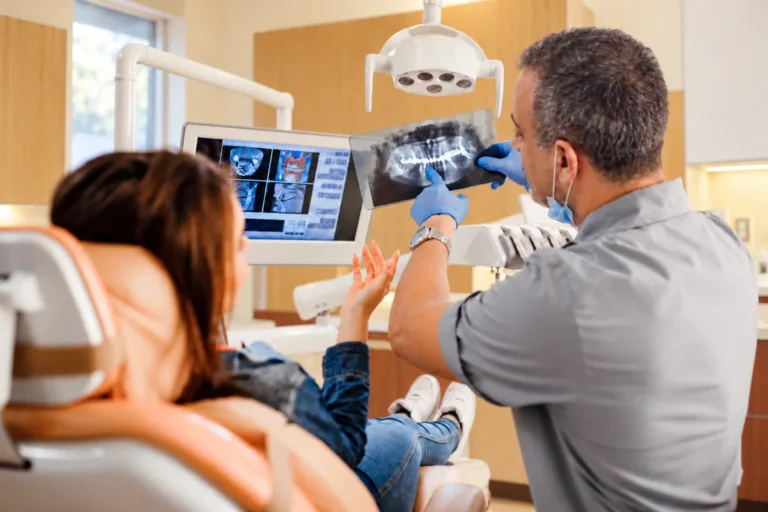
• Taking selected dental X-rays. [7]
The aim is to connect the familiar pain with findings that explain it. If the source remains uncertain, further evaluation or referral may be more useful than starting irreversible treatment. Pain felt in a tooth can occasionally originate in jaw muscles or other structures. [6]
Why an X-ray may look normal
X-rays can help assess decay, bone support, and changes around a root. However, a fine crack or an early problem may not be visible. Even a three-dimensional scan cannot reliably reveal every crack; additional imaging should answer a specific clinical question. [4,5,7]
At Highlands Dentistry, microscope magnification supports a detailed view when indicated. It is one part of the examination. Seeing a surface line does not, by itself, establish its depth or determine treatment. [7]
For more on imaging decisions, read Do You Need Dental X-rays at Every Checkup?.
What treatment may involve
Treatment depends on the diagnosis and whether the tooth can be predictably restored. Possibilities include correcting a problematic filling, repairing decay, or protecting a damaged tooth with a suitable restoration. Some cracked teeth need root canal treatment as well as restoration; a deeply split or otherwise unrestorable tooth may need removal. Biting pain alone does not choose among these options. [1,2,3]
Antibiotics are not a routine answer to tooth pain. ADA guidance recommends dental treatment rather than antibiotics for most pulpal and root-related conditions in adults who are not severely immunocompromised. Systemic illness or spreading infection can change that decision. [8]
What to do before your appointment
Choose softer foods and avoid chewing on the painful tooth. Avoid foods or drinks that trigger discomfort. If you need temporary pain relief, ask a dentist or pharmacist which over-the-counter medicine is safe with your health conditions and other medications, and follow the label. Pain relief does not replace an examination. [9,10]
Do not place aspirin directly against the tooth or gum; it can injure the tissue. [4]
When to seek prompt or emergency care
Arrange a dental evaluation for recurring biting pain. Seek urgent dental care for swelling, fever, worsening or uncontrolled pain, or signs of an abscess. If your dentist is unavailable, contact an available urgent dental service. [1,4,9]
For trouble breathing or swallowing, or swelling around the eye or neck, seek emergency medical care immediately. Call 911 for breathing difficulty or another life-threatening emergency. [9]
Getting the right next step in Issaquah
At Highlands Dentistry, we explain what we find, what remains uncertain, and which options fit the diagnosis.
For a nonurgent concern, request a dental appointment. For urgent dental concerns, call (425) 996-0457 during office hours: Monday–Thursday, 7:00 a.m.–4:00 p.m. Our office is closed Friday–Sunday. Please do not use the online form for urgent or emergency care.
About the author
Ray Besharati, DDS, DMD
Doctor of Dental Medicine, Tufts University
Advanced Training in TMJ & Orofacial Pain
Master of Science in Orofacial Pain and Oral Medicine, University of Southern California
This article provides general education. An examination is needed to diagnose an individual tooth problem.
Sources and further reading
Numbers in the article correspond to the references below. Clinical guidance supports general education; individual treatment depends on examination findings.
1. American Association of Endodontists. Tooth Pain. Patient guidance; accessed October 22, 2026.
2. Cleveland Clinic. Dental Fillings. Updated May 13, 2024; accessed October 22, 2026.
3. American Association of Endodontists. Cracked Teeth. Patient guidance; accessed October 22, 2026.
4. MedlinePlus Medical Encyclopedia. Tooth abscess. Reviewed February 5, 2026; accessed October 22, 2026.
5. National Institute of Dental and Craniofacial Research. Periodontal Gum Disease. Accessed October 22, 2026.
6. American Academy of Orofacial Pain. Toothaches of Non-dental Origin. Patient brochure; publication date not stated; accessed October 22, 2026.
7. Patel S, Teng PH, Liao WC, et al. Position statement on longitudinal cracks and fractures of teeth. International Endodontic Journal. 2025;58:379–390. doi:10.1111/iej.14186. ESE expert consensus.
8. American Dental Association. Antibiotics for Dental Pain and Swelling Guideline. 2019 guideline; current resource accessed October 22, 2026.
9. NHS. Toothache. Patient guidance; accessed October 22, 2026. Emergency actions in this article are adapted for United States readers.
10. American Dental Association. Acute Pain Management Toothache. Living guideline resource; latest evidence search listed as July 2026; accessed October 22, 2026.