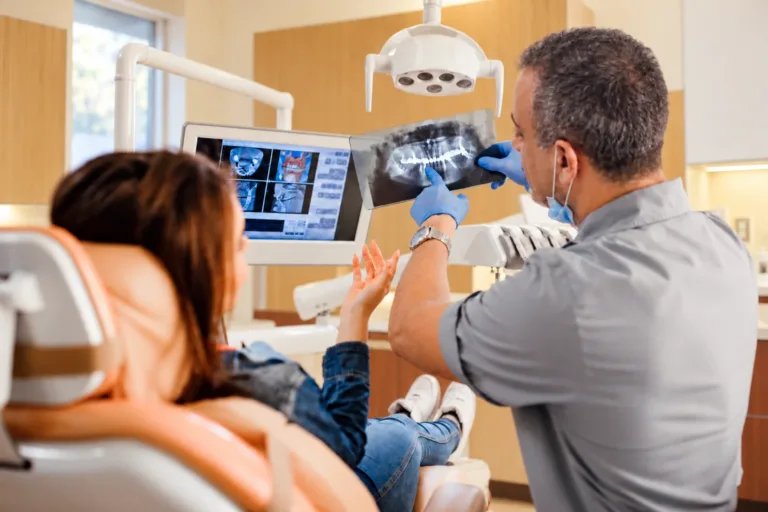
Not automatically. Whether you need dental X-rays at a checkup depends on your oral health, risk of disease, current examination, and the images already available. A checkup does not automatically mean a new set of X-rays. [1, 2]
The 2026 recommendations from the American Dental Association and the American Academy of Oral and Maxillofacial Radiology reinforce this approach: review the history, examine the patient, and consider previous images before ordering more. [1]
What an image can add to your examination
Some problems are difficult to see by looking in the mouth alone. Dental X-rays can reveal decay between teeth or a tooth that has not erupted normally. The image adds information to the examination; it does not replace it. [2, 3]
That also means feeling comfortable is not enough to decide whether imaging is useful. The question is whether an image can provide information needed for your care. [1, 2]
Why the interval varies
A history of recent cavities, significant dry mouth, and frequent exposure to sugary foods or drinks can raise cavity risk. Those factors help explain why two people who attend similar checkups may have different imaging plans. [3]
For adult recall patients, the 2026 recommendations include these ranges for posterior bitewing X-rays, the small images often used to look for decay between back teeth. [1]
| Adult cavity risk at recall | Posterior bitewing interval |
|---|---|
| No clinical decay and not at increased cavity risk | 24–36 months |
| Clinical decay or increased cavity risk | 6–18 months |
These ranges guide cavity monitoring. They do not set a schedule for every kind of dental image or mean you should wait if a new concern develops. Pain, an injury, gum disease, or another clinical finding may require a different image or timing. Your dentist should explain how the recommendation applies to you. [1]
Can your previous images be used?
If you are changing dentists, ask your previous office to transfer your images before the appointment. Your new dentist may be able to use them instead of taking new ones. [2]
Whether they are sufficient depends on what they show and what information is needed now. A recent image of one area may not answer a question about another. [1]
How to think about radiation
Conventional dental X-rays generally involve very low radiation exposure, but exposure still deserves care. The aim is to obtain the information needed with the lowest exposure that produces a useful diagnostic image. [2, 4]
Appropriate image selection, limiting the beam to the area being examined, and careful positioning help reduce unnecessary exposure and repeat images. [4]
Why an office may no longer use a lead apron
In 2024, the ADA stopped recommending routine patient lead aprons and thyroid collars for dental imaging. These shields can sometimes cover part of the image and lead to a retake. Practices must still follow applicable radiation regulations, which can affect local procedures. Ask the team if a change in the routine concerns you. [4]
A 3D scan needs its own reason
A cone-beam CT scan, often called CBCT, produces a three-dimensional view. It can help answer certain diagnostic or treatment-planning questions, but typically involves more radiation than conventional dental X-rays. It should be selected when the information needed cannot be obtained adequately with lower-exposure options. [5]
What about children?
Children also need an individual assessment. Their greater sensitivity to radiation makes careful selection and exposure settings suited to their size especially important. The adult ranges above should not be applied to children. [6]
Questions worth asking
- What are you looking for with this image?
- Can my previous images answer that question?
- What makes this timing appropriate for me?
- How could the result change my care?
For your next visit to Highlands Dentistry in Issaquah, bring the date and location of your most recent dental images. Ask Dr. Ray which images, if any, would help guide your care. Call (425) 996-0457.
This article provides general education. Imaging recommendations require an individual dental assessment.
References
- Benavides E, Krecioch JR, Allareddy T, et al. American Dental Association and American Academy of Oral and Maxillofacial Radiology patient selection for dental radiography and cone-beam computed tomography: Clinical recommendations. JADA. 2026;157(1):20–35. doi:10.1016/j.adaj.2025.10.013. Open-access full text. The interval ranges support clinical judgment and are not individual prescriptions.
- American Dental Association. X-rays. MouthHealthy.
- American Dental Association. Caries Risk Assessment and Management.
- American Dental Association. ADA Releases Updated Recommendations to Enhance Radiography Safety in Dentistry. February 1, 2024.
- US Food and Drug Administration. Dental Cone-beam Computed Tomography.
- US Food and Drug Administration. Pediatric X-ray Imaging.
Sources accessed October 15, 2026.