Grinding may not be a habit you need to break. It may be something your body is doing on purpose — and that changes what you should do about it.
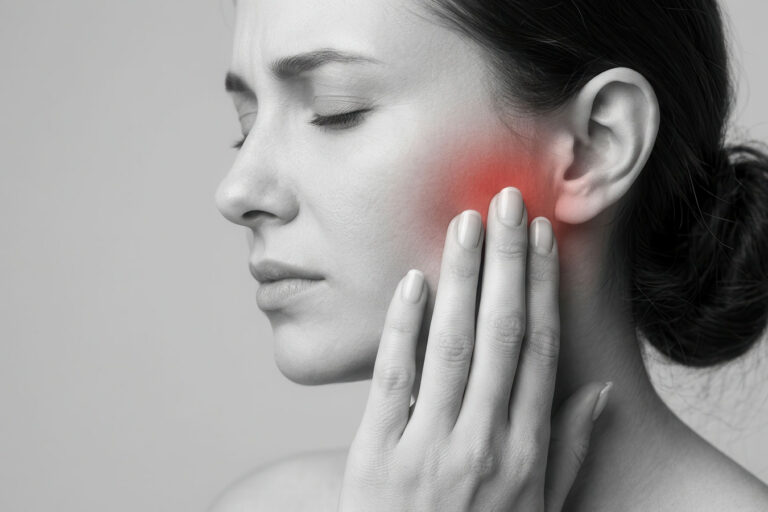
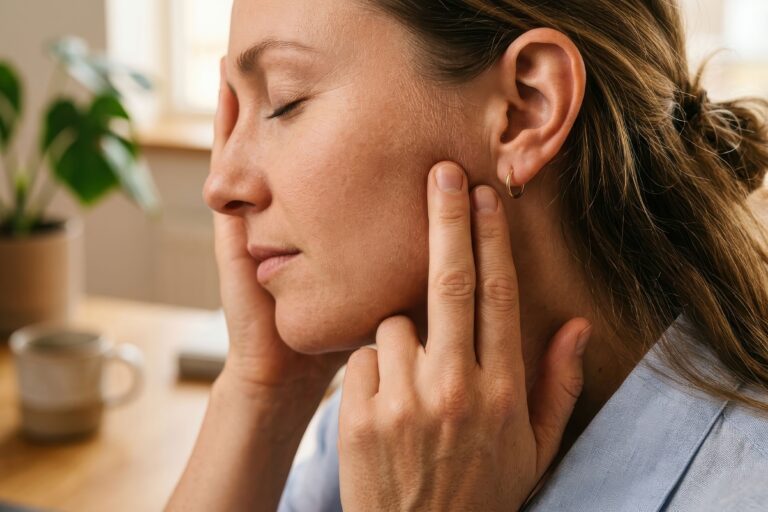
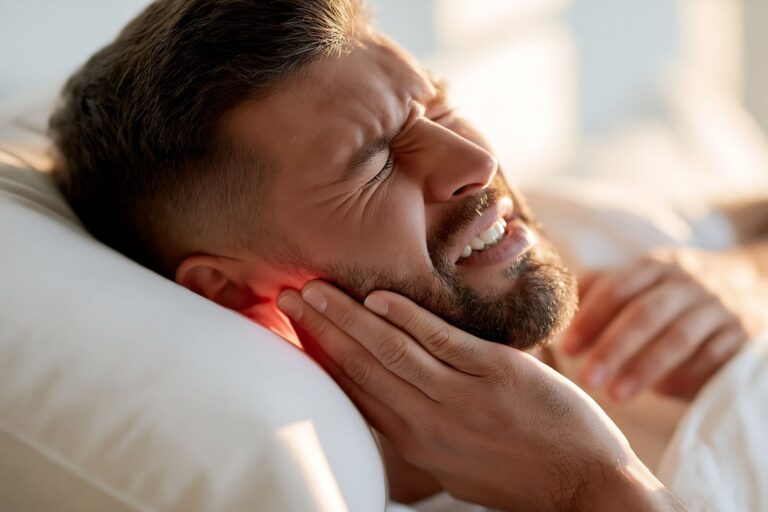
You wake up before the alarm. Your jaw is tight in a way it wasn’t when you went to bed. There’s a dull band of ache across your temples, your back teeth feel slightly foreign, and it takes twenty minutes and a cup of coffee before your face feels like your own again.
Nothing happened. You didn’t fall. You weren’t hit. You slept — and you woke up sore.
Almost everyone who has this experience gets the same explanation: you grind your teeth. And that explanation is usually correct as far as it goes. The problem is that it stops one question too early.
Grinding isn’t a habit. It’s an event.
Most people picture nighttime grinding as a version of something they already do while awake — chewing a pen, biting a nail, clenching in traffic. A bad habit, just unconscious. Something you should be able to stop if you relaxed more, or cared more, or tried harder.
That picture is wrong, and it’s worth replacing, because it shapes every decision that follows.
Sleep bruxism is now understood as a sleep-related motor activity, not a parafunctional habit. It doesn’t run continuously through the night. It arrives in bursts — short, rhythmic episodes of jaw muscle activity, often clustered, often concentrated in particular stages of sleep. Many of these episodes are preceded by a micro-arousal: a brief shift toward lighter sleep, lasting a few seconds, that you will never remember. Heart rate ticks up. The nervous system leans forward. Muscles across the body recruit — and the jaw is among the first to answer.
You are not choosing any of this. Which is why “just stop grinding” has never worked for anyone, and why it isn’t a reasonable thing to ask of a patient. You cannot break a habit you are not awake for.
The better question — the one that actually opens the case — is this: what is your body responding to?
The candidates
There are several, and they are not mutually exclusive.
Stress and autonomic load are real contributors, and the version of this you’d expect is true: high-arousal periods in life show up in the muscles at night. So do certain medications, particularly some antidepressants. So do alcohol close to bedtime, nicotine, heavy caffeine, and reflux. So does fragmented, low-quality sleep in general, from any cause.
And then there’s the one that gets the least attention in a dental office, which is breathing.
Here I want to be careful, because this is a place where the field has moved and the public conversation hasn’t caught up.
The association between sleep bruxism and obstructive sleep apnea is well documented. People who have one are more likely to have the other. That much is not controversial.
What is still unsettled is the direction of the arrow. A 2025 systematic review of the last five years of evidence concluded that while an association is clearly suggested, the causal relationship remains unclear. And some of the most interesting recent work points somewhere genuinely unexpected: one 2024 study found that bruxism frequency actually decreased as apnea severity increased, and a 2025 study found that people with a low arousal threshold showed more intense jaw activity — both of which have been read as evidence that the jaw movement may be compensatory. Possibly even useful. Possibly a mechanism that helps end a respiratory event rather than a symptom of one.
Sit with that for a second, because it inverts the usual framing entirely.
We do not yet know, in any given person, whether the jaw is the culprit or the first responder.
That uncertainty is not a reason to shrug. It’s the opposite. It means grinding is neither proof of a breathing problem nor safe to file away as harmless noise. It’s a reason to look.
Which makes the night guard question more interesting than it appears
A guard protects enamel. That’s real, it matters, and I make them. Worn teeth don’t grow back, and a well-made appliance is often the difference between a decade of stability and a decade of restorative dentistry.
But two things are also true.
First, an appliance generally does not stop the muscle activity. It changes what the activity lands on. Patients are frequently surprised by this — they’ve been told the guard will “fix the grinding,” and then they wake up with a sore jaw and a scuffed appliance and assume something failed. Nothing failed. The guard did exactly what a guard does.
Second — and this is the part that deserves care rather than alarm — putting an appliance between the teeth of someone with a breathing problem is not automatically a neutral act. A small pilot study from 2004 raised this question and has been argued about ever since: in a group of ten patients with confirmed sleep apnea, an upper flat-plane splint produced a greater-than-50% increase in the apnea-hypopnea index in half of them. But the overall difference across the group was not statistically significant, the sample was tiny, and later work has not reliably reproduced the effect.
So the responsible conclusion is emphatically not “night guards cause sleep apnea.” Anyone telling you that is overreading a pilot study.
The responsible conclusion is about sequence. An appliance is a modification to the environment your airway operates in all night. It is worth knowing what that environment looks like before you change it — not because the change is likely to hurt you, but because the same conversation that establishes the baseline is the one that might find something more important than the grinding.
This isn’t an argument against the guard. It’s an argument for asking the breathing question first, rather than after three appliances haven’t solved the problem.
What a thorough evaluation actually asks
If you bring morning jaw pain to me, these are the threads I’m pulling:
When is it worst? Morning-dominant pain that eases through the day points toward something happening during sleep. Pain that builds through the afternoon points toward daytime clenching, which is a different behavior with different management.
What else is happening at night? Morning headache, dry mouth, sore throat on waking, unrefreshing sleep despite adequate hours, or a partner who has mentioned snoring or pauses. Any of these shifts the weight of the investigation.
What is the joint itself doing? Noise, catching, limited opening, or a change in how the teeth meet. (If you’ve been hearing clicking, that has its own answer, and it’s usually more reassuring than people expect.)
What changed? New medication, a new stress load, nasal congestion, seasonal allergies, a shift in alcohol timing, a change in weight. The timeline often does more diagnostic work than any imaging.
What do the muscles say on exam? Masseter, temporalis, medial pterygoid — and specifically, whether palpating them reproduces the exact headache you’ve been describing. That single finding reorganizes a lot of cases.
Notice how little of that is about teeth. That’s not an oversight. Morning jaw pain is a whole-night problem that happens to be measured at the teeth.
The reframe
In an earlier post I made the case that a clicking jaw is usually a sound rather than a warning — that noise, on its own, is weak evidence of anything.
A jaw that is sore every single morning is a different category. That’s not noise. That’s a signal, repeated nightly, that something in your sleep is asking your body to work.
The goal, then, isn’t really to stop the jaw. The goal is to make the night quiet enough that the jaw has nothing to answer.
Protect the teeth — yes, absolutely, and often right away. But protect them while you investigate the night, not instead of investigating it. The appliance addresses the consequence. The interesting work is one level up.
If you wake up sore most mornings, you can learn more about a TMJ and orofacial pain evaluation or go ahead and request an evaluation, and we’ll look at the whole night rather than just the teeth.
Common questions
Is nighttime grinding caused by stress?
Stress is a genuine contributor, but it’s rarely the whole story. Sleep quality, breathing, medications, reflux, and alcohol all influence nighttime jaw muscle activity. Treating it as purely a stress problem is what leaves people managing the same symptom for years.
Will a night guard stop me from grinding?
Usually not. A guard is designed to protect teeth from the forces involved, not to switch off the muscle activity itself. Waking with a sore jaw while wearing a guard is common and doesn’t mean the guard is failing at its job.
Should I have a sleep evaluation if I grind my teeth?
Not everyone who grinds has a breathing problem — the evidence does not support that claim. But grinding is one of several findings that make the question worth asking, especially alongside morning headache, snoring, or unrefreshing sleep. It’s a screening conversation, not a foregone conclusion, and it’s part of a sleep and airway evaluation.
Can morning jaw pain mean something other than grinding?
Yes. Joint inflammation, arthritic change, muscle disorders, primary headache conditions, and other orofacial pain presentations can all produce morning symptoms. That’s exactly why the evaluation matters more than the assumption.
References
García Doblado N, et al. Relationship Between Bruxism and Obstructive Sleep Apnea: A Systematic Review of the Literature. J Clin Med. 2025;14(14):5013.
Gagnon Y, Mayer P, Morisson F, Rompré PH, Lavigne GJ. Aggravation of respiratory disturbances by the use of an occlusal splint in apneic patients: a pilot study. Int J Prosthodont. 2004;17:447–453.
Cid-Verdejo R, et al. (2024) — on bruxism frequency relative to apnea severity.
Martynowicz H, et al. (2025) — on arousal threshold and sleep bruxism intensity.
Meira e Cruz M. A novel method to identify endotypes and risk factors related to co-occurring obstructive sleep apnea and sleep bruxism. Sleep. 2025;zsaf238.
Ray Besharati is a practicing general dentist with advanced training and a clinical focus in orofacial pain and TMJ disorders. He holds a DMD from Tufts University and a master’s degree in orofacial pain from the University of Southern California, and has practiced clinical dentistry for more than 25 years.
This article is general education and not a substitute for an individual evaluation. Jaw pain has many causes, and the right approach depends on findings specific to you.