Snoring is the sound of a narrow airway. It is not, by itself, the danger. The danger is quieter — and it comes right after.
You’ve probably heard the recording. Most people reading this have — a partner holds up a phone at breakfast, presses play, and there you are: a sound you would never have believed came from you, time-stamped at 2:14 a.m.
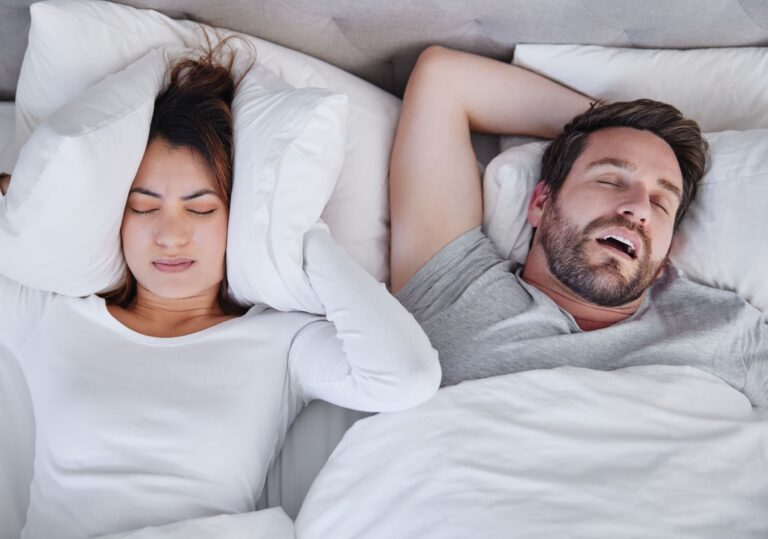
The snore gets absorbed into a household the way most chronic things do. First it’s an elbow in the ribs. Then it’s a joke at dinner parties. Then a white-noise machine, then earplugs, then — quietly, without anyone announcing it — the guest room. Somewhere in that progression, everyone stopped asking what the sound actually is.
So let’s ask.
What a snore actually is
When you fall asleep, the muscles that hold your throat open go off duty. The throat is not a rigid pipe — it’s a soft-walled tube kept patent by muscle tone you never think about while you’re awake. Lose that tone, and the tube narrows. Air moving through a narrower passage speeds up, the soft tissue around it begins to flutter, and the flutter is the sound. A snore is turbulence.
Everyone’s airway narrows at night. A snorer’s narrows enough to make noise. That’s the whole difference, and it explains why the sound gets worse in exactly the situations you’d predict: on your back, when gravity helps the tongue drift rearward; after alcohol, which relaxes those muscles further; during allergy season, when the nose forces you onto mouth breathing; with weight gain around the neck; and simply with age, as tissue softens.
Which brings us to the sentence most websites in this category will not print: many people who snore every night of their lives are, medically speaking, fine. The snore is a plumbing report, not a diagnosis. On its own, it tells you the airway is narrow. It does not tell you the airway is failing.
The sound is not the signal. The silence is.
Here is the distinction that reorganizes everything else in this subject.
A snore means air is still moving — noisily, inefficiently, but moving. An apnea means the tube has closed. The pattern, once you know it, is unmistakable: the snoring builds, then stops mid-phrase. Silence — ten seconds, twenty, sometimes longer — while the chest keeps working against a sealed airway. Oxygen drifts downward. Then the brain surfaces just enough to fire the throat muscles, and the silence breaks with a gasp or a snort, and the sleeper — who remembers none of this — settles back down. In some people that cycle repeats dozens of times an hour, all night, for years.
If you read the piece on the jaw that locked, you’ll recognize the grammar. There, the click — the noisy part — was mostly benign, and the click going quiet was the finding. Same structure here. The snore is the airway complaining. The silence is the airway closing.
This produces the strangest feature of the whole condition: its most important witness is asleep in the other half of the bed. You cannot hear your own snore, and you certainly cannot hear your own silences. Sleep apnea may be the only common, serious condition whose chief witness is not the patient — which is why the diagnosis so often walks into an office holding someone else’s phone.
Three questions before any checklist
Symptom lists are everywhere, and they mostly teach people to be vaguely worried. More useful is learning to read your own signal. Three questions do most of the sorting.
First: what happens after the snore? A steady, even sawing that runs all night is one story. A snore that keeps stopping — silence, then a gasp or choke, then resumption — is a different story entirely. If you don’t know which pattern is yours, the answer is one favor away: ask whoever shares your room to listen for the stops, or to record ten minutes of it. That recording is worth more than any questionnaire.
Second: what do your mornings look like? Waking with a headache that fades over the first hour, a dry mouth or raw throat, and — the real tell — feeling unrefreshed after a full night in bed. Eight hours that spend like five. Fragmented sleep doesn’t feel like waking up all night; it feels like sleep that stopped working.
Third: what does 3 p.m. feel like? Distinguish tired, which describes most adults, from sleepy — falling asleep without deciding to. Drifting off in meetings, on the couch at 8:30, in the passenger seat. And the version that outranks everything else in this article: fighting sleep behind the wheel. That single answer moves an evaluation from “sometime” to “soon.”
Those three questions divide snorers into two groups, and the groups get very different advice.
The snorer who’s probably fine
If you snore mainly on your back and go quiet on your side; if it tracks allergy season or the second glass of wine; if nobody has ever heard you stop and start; if you wake clear-headed and your afternoons hold — then what you have is most likely a noise problem. A real one, possibly a marital one, but a nuisance rather than a condition.
The honest fixes are unglamorous and free. Sleep on your side — there are modern, comfortable versions of the old tennis-ball-in-the-T-shirt trick. Treat the nose: a congested nose forces mouth breathing, and mouth breathing amplifies everything. Move alcohol earlier in the evening. Address weight where it applies, without pretending that’s a quick or universal answer.
And yes — even plain snoring can be treated when the sound itself is the problem. The joint physician–dentist guideline in this field explicitly supports a custom oral appliance for primary snoring when a patient wants one. A marriage is allowed to be the indication.
But the sequence matters, and this is the one genuinely bad move available to you: silencing the snore without first checking what’s behind it. A quieter night is not automatically a safer one. A generic device that mutes the sound can also mute the signal, and the signal is the entire reason to pay attention. Rule out the silences first. Then quiet the snore with a clear conscience.
When the sound becomes a finding
The picture changes when the snore keeps company. Witnessed pauses. Waking with a gasp or a choking sensation. Sleepiness that intrudes uninvited — especially while driving. Morning headaches. Blood pressure that stays stubborn despite treatment. Getting up to urinate several times a night. A snore loud enough to be heard through a closed door. Any one of these is worth a conversation. Pauses plus daytime sleepiness is worth a test.
And this is not a niche situation. The most comprehensive global analysis to date estimated that nearly a billion adults aged 30 to 69 have obstructive sleep apnea to some degree, with roughly 425 million in the moderate-to-severe range — and the large majority have never been tested. It is a common condition with a public-relations problem: its calling card sounds like a punchline.
The reason to take it seriously is the arithmetic of repetition. One obstructed breath is nothing. The same pattern — obstruction, oxygen dip, stress surge, fractured sleep — repeated dozens of times an hour, every night, for a decade, is a different kind of load. Untreated moderate-to-severe sleep apnea is associated with high blood pressure, heart-rhythm problems, and broader cardiovascular and metabolic disease; the American Heart Association considers the link strong enough to have issued a formal scientific statement about it. The responsible phrasing is associated with — this is a risk pattern, not a verdict, and treating apnea is not a cardiology prescription. But a physiologic stress test you unknowingly run every night for years is worth identifying, precisely because it’s identifiable. And treatable.
Why a dentist is writing about your sleep
Because the mouth keeps a diary of the night, and dentists are the only clinicians who read it up close, in good light, twice a year, while you’re awake.
Tooth edges flattened and polished by grinding. Scalloped borders along the tongue where it presses against the teeth. A high, narrow palate. A crowded view of the back of the throat. A patient who mentions, in passing, that their jaw is sore in the mornings. None of these is a diagnosis. Together, they are a pattern — and noticing patterns early is most of what prevention actually is.
Now the boundary, stated plainly, because plenty of marketing blurs it: a dentist cannot diagnose sleep apnea. Neither can any clinician by looking at your throat. The diagnosis is made by a sleep test — increasingly done at home with a small sensor kit over a night or two — interpreted by a physician. What a dentist can legitimately do is recognize the pattern, refer you for that test, and, for the right patients after a diagnosis, provide one specific treatment in coordination with your physician.
That treatment is a custom, adjustable oral appliance that holds the lower jaw slightly forward during sleep, tensioning the airway walls so they’re less prone to collapse. The joint guideline from the sleep-medicine and dental-sleep-medicine academies positions it honestly: recommended for people with sleep apnea who can’t tolerate CPAP or prefer an alternative, with CPAP remaining the default for moderate-to-severe disease because it lowers the event count further. That’s the trade in one sentence — CPAP is stronger per hour of use, and appliances tend to get used for more hours. In head-to-head trials, several of the outcomes people actually feel, blood pressure among them, have landed closer together than the raw numbers would predict, largely because the appliance was actually being worn. The best therapy is the one that’s in your mouth, or on your face, at 3 a.m. — not the one with the better spec sheet sitting in the nightstand drawer.
Part of this work is also pointing away from my own chair. Severe disease, complicated medical pictures, the patient CPAP is serving well — those belong with a sleep physician, and an office that never says so is selling appliances rather than managing airways.
One more connection, because it ties this post to an earlier one. If you snore and wake with a sore jaw, that overlap is worth knowing about: grinding and disturbed breathing show up in the same patients often enough that the association is well documented, though which one drives the other is still being argued in the literature. Practically, it means a snore plus a sore morning jaw deserves one evaluation that looks at both — not a night guard from one office and a nasal strip from another, each treating half a pattern.
The reframe
You cannot observe your own sleep. You can only observe its residue.
That’s the quiet epistemology underneath this whole subject, and it’s why the useful question was never do I snore? — a question about sound, addressed to the one person who can’t hear it. The useful question is what do my nights leave behind? The mornings. The afternoons. The recording on someone’s phone. The blood pressure reading that won’t come down. Answer those, and the snore question resolves itself: a nuisance for some people, a finding for others, decided by evidence rather than by volume.
If the silences sound familiar — or the mornings do — that’s worth a conversation, and the first step is smaller than most people expect.
You can learn more about a sleep and airway evaluation or go ahead and request an evaluation, and we’ll look at the whole night rather than just the noise.
Common questions
Is snoring always sleep apnea?
No. Many people snore without apnea, particularly positional or congestion-related snorers. The discriminators are what happens around the snore: witnessed pauses, gasping arousals, unrefreshing sleep, and daytime sleepiness. Only a sleep test can confirm or rule out apnea.
Can a dentist diagnose sleep apnea?
No — and no clinician can diagnose it from an exam alone. Diagnosis requires a sleep test interpreted by a physician. A dentist’s role is to recognize the warning pattern, refer for testing, and, for appropriate patients after diagnosis, provide oral appliance therapy in coordination with the treating physician.
Do oral appliances work as well as CPAP?
CPAP reduces breathing events more powerfully and remains the first-line recommendation for moderate-to-severe sleep apnea. Custom oral appliances are recommended by the joint physician–dentist guideline for people who can’t tolerate CPAP or prefer an alternative, and they tend to be worn more consistently. The right choice depends on severity, anatomy, and candor about what you’ll actually use — decided with a sleep physician involved.
What is a sleep study actually like?
For many people, it’s now a home test: a small sensor kit worn for a night or two in your own bed, returned or uploaded afterward. In-lab studies are reserved for more complex situations. The barrier is far lower than most people imagine.
My partner snores and refuses to get checked. What helps?
A recording. Ten minutes of the actual pattern — including the stops — does more than a month of urging, because the snorer has genuinely never heard it. Bring the recording to any appointment; it’s useful clinical information.
I grind my teeth and I snore. Are they related?
They appear together often enough that the association is well documented, though the direction of cause is still debated. The practical takeaway: that combination deserves a single evaluation that considers both the jaw and the airway together.
References
Benjafield AV, Ayas NT, Eastwood PR, et al. Estimation of the global prevalence and burden of obstructive sleep apnoea: a literature-based analysis. Lancet Respir Med. 2019;7(8):687–698.
Peppard PE, Young T, Barnet JH, Palta M, Hagen EW, Hla KM. Increased prevalence of sleep-disordered breathing in adults. Am J Epidemiol. 2013;177(9):1006–1014.
Young T, Evans L, Finn L, Palta M. Estimation of the clinically diagnosed proportion of sleep apnea syndrome in middle-aged men and women. Sleep. 1997;20(9):705–706.
Ramar K, Dort LC, Katz SG, et al. Clinical practice guideline for the treatment of obstructive sleep apnea and snoring with oral appliance therapy: an update for 2015. J Clin Sleep Med. 2015;11(7):773–827.
Phillips CL, Grunstein RR, Darendeliler MA, et al. Health outcomes of continuous positive airway pressure versus oral appliance treatment for obstructive sleep apnea: a randomized controlled trial. Am J Respir Crit Care Med. 2013;187(8):879–887.
Trzepizur W, Cistulli PA, Glos M, et al. Health outcomes of continuous positive airway pressure versus mandibular advancement device for the treatment of severe obstructive sleep apnea: an individual participant data meta-analysis. Sleep. 2021;44(7):zsab015.
Yeghiazarians Y, Jneid H, Tietjens JR, et al. Obstructive sleep apnea and cardiovascular disease: a scientific statement from the American Heart Association. Circulation. 2021;144(3):e56–e67.
Jokubauskas L, Baltrušaitytė A. Relationship between obstructive sleep apnoea syndrome and sleep bruxism: a systematic review. J Oral Rehabil. 2017;44(2):144–153.
Ray Besharati is a practicing general dentist with advanced training and a clinical focus in orofacial pain, TMJ disorders, and dental sleep medicine. He holds a DMD from Tufts University and a master’s degree in orofacial pain from the University of Southern California, and has practiced clinical dentistry for more than 25 years.
This article is general education and not a substitute for an individual evaluation. Snoring and sleep-related symptoms vary from person to person, and only a physician-interpreted sleep test can diagnose or rule out sleep apnea.